Building AI Agents for Legal Tech: Harness Design, Evidence, and Evaluation
How context, tools, memory, and feedback help legal AI agents finish useful work, with Python examples for evidence checks and evaluation.
Suppose a source document says, “Management expects the programme to reduce operating costs next year.” The agent writes, “The programme reduced operating costs this year,” and attaches a citation to that document.
The citation resolves. The quotation exists. The answer is still wrong: an expectation has become a reported result, and the period has changed.
Building AI for legal work has made this distinction hard to ignore. Generating a paragraph is one problem; giving a lawyer enough evidence to defend it is another. The engineering work sits between those two: retrieving the right material, preserving what it says, checking the output, and keeping document changes under the reviewer's control.
This article works through a disclosure-comparison task to show how to build that surrounding system: the agent harness. Anthropic describes the harness as the loop that calls the model and routes its tool calls. Here, that loop connects the model to documents, search, saved progress, and feedback so it can carry a task through several steps.
Start with a specific task
Consider this request:
Compare the selected risk-factor section with two peer filings. Preserve exact peer wording in the comparison, identify missing information, and propose a revision for review.
The model starts with the selected document, its version, the company, the reporting period, and the peers to compare. Some of this context comes from the user's selections; the rest can come from document metadata. When a detail is missing, the agent can inspect the available documents or ask a focused question. It should not have to rediscover information the interface already collected.
The response needs four parts:
| Object | Required information | Purpose |
|---|---|---|
| Source passage | Document identity, version, offsets, exact text | Make the evidence inspectable |
| Comparison finding | Target passage, peer passage, interpretation | Explain a difference without treating peer facts as target facts |
| Proposed revision | Base document version, replacement text, evidence references | Present a concrete change for review |
| Open question | Missing fact, why it matters, requested input | Continue when evidence is insufficient |
This separation prevents a common failure: copying another company's disclosure into a target-company draft as though the underlying facts were interchangeable. A peer passage establishes what the peer disclosed. It does not establish that the target company has the same exposure, controls, or financial position.
A fixed pipeline is sufficient when the request always follows the same steps. An agent loop becomes useful when retrieved evidence determines whether to read more, ask a question, or propose a revision. Give the agent tools for those decisions—search, reading, comparison, and editing—and define what each tool returns. The sequence can change with the evidence while the result remains understandable: a comparison, proposed wording, and any unresolved questions.
What the harness needs to do
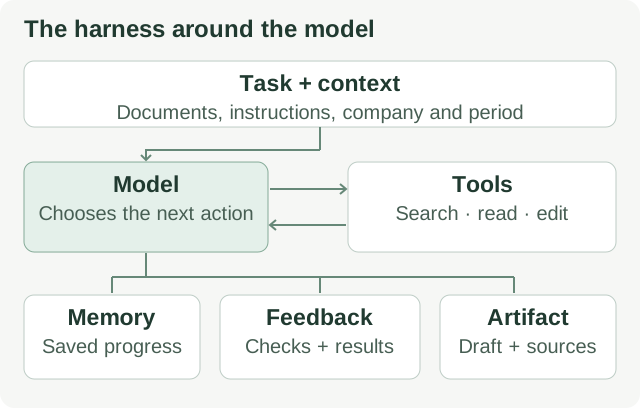
The harness makes the model's decisions executable. When the model requests a search, it runs the search and returns the passages. When the model drafts a section, it saves that draft. When a check finds a problem, it returns enough detail for the model to correct it.
For this task, the agent can move between reading, searching, comparing, drafting, and asking questions as needed. The harness supports that autonomy by preserving context and making the results of each action available to the next decision.
Give each tool a clear input, result, and effect:
| Tool | Input | Result | Effect |
|---|---|---|---|
search_passages | Query, company and period filters | Ranked passage handles | Read |
read_passage | Handle returned by retrieval | Text and source metadata | Read |
ask_clarification | Missing fact and focused question | Suspended task awaiting input | State change |
propose_revision | Base version, text, evidence handles | Reviewable proposal | Creates artifact |
The request in this example asks for a revision for review, so the useful output is a proposed diff. A task that asks the agent to edit a working draft could instead expose an editing tool. Tool design should reflect the job: searching for precedent, preparing a proposal, and editing a document are different operations, not reasons to require confirmation at every step.
A minimal control loop can be expressed as pseudocode:
restore the task's context and saved progress
repeat:
    give the model the task, tools and latest results
    let it choose the next action
    execute the tool call and return its result
    save new evidence, decisions and draft changes
    if a check finds a problem: return specific feedback
    if the task is complete: return the artifact
    if user input is needed: save the question and wait
The feedback should be actionable. Instead of “citation invalid,” return “reference 12 points to a passage that was not retrieved,” together with the available references. The agent can then read the correct source or revise the claim. If two attempts produce the same failure without new evidence, repeating the same call is unlikely to help; the next useful move may be another search or a question for the user.
Track time, cost, and progress so a stalled run is visible. Choose stopping rules for the task rather than imposing a tiny tool-call limit on work that genuinely requires investigation. The aim is to keep useful work moving and preserve the result when it cannot continue.
Give the agent reusable procedures
A skill can specify that comparison output must quote peer passages exactly, distinguish precedent from target-company evidence, and ask for material facts absent from the supplied documents. It should describe a reusable procedure rather than enumerate answers to individual evaluation cases.
Skills explain how to do the work; tool implementations perform it. A comparison skill can describe how to choose useful peer passages, while a retrieval tool returns the passage text and source location. Access checks still belong in the document service, as in any multi-user product. They are separate from the model's freedom to decide which relevant source to read next.
I have found it easy to fix a failing example by adding an instruction, only to break a similar request. Before adding another exception, investigate where the failure occurred. Missing source text is an extraction problem. Wrong company scope is a retrieval or context problem. Unsupported interpretation needs semantic evaluation. They should not all become instructions appended to the same system prompt.
Keep the source attached to the claim
Extraction should produce a stored text representation with a stable document identifier and version. This is the canonical text against which references will be checked. Preserve company, filing type, reporting period, section identity, and source location alongside it. A number without its table header or period is incomplete evidence even if the digits were extracted correctly.
Search operates over these records. Lexical retrieval can help with exact phrases and identifiers; semantic retrieval can help when wording varies. A hybrid implementation can merge candidates before reranking. Evaluate those choices on evidence needed for the task rather than assuming a more elaborate retriever is better.
Search within the selected companies and periods, then keep a registry of the passages returned. Each passage gets a handle: an identifier the model can use to read or cite it later. Resolve that handle against the retrieved text so a reference leads back to the actual passage, even after the agent has performed several other steps.
A reference can carry the source version, the quoted text, and its position:
from dataclasses import dataclass
from hashlib import sha256


def digest(text: str) -> str:
    return sha256(text.encode("utf-8")).hexdigest()


@dataclass(frozen=True)
class Evidence:
    source_id: str
    content_hash: str
    start: int
    end: int
    quote: str
The hash identifies the exact canonical text used by this example. Offsets are half-open Python string indices into that text, not PDF coordinates or UTF-8 byte offsets. A real extraction pipeline needs a separate mapping from canonical spans to page locations or bounding boxes, with the extraction version retained.
The following check establishes that a quotation matches the registered source version:
def verify_evidence(ref: Evidence, sources: dict[str, str]) -> bool:
    text = sources.get(ref.source_id)
    if text is None or digest(text) != ref.content_hash:
        return False
    if not 0 <= ref.start < ref.end <= len(text):
        return False
    return text[ref.start:ref.end] == ref.quote
The sources mapping contains the source texts retrieved during this run. Build it from tool results, rather than asking the model to recreate the documents it read. Python dataclasses also do not validate incoming JSON types; parse and validate untrusted input before constructing these internal objects. This distinction follows the Python dataclass contract.
The opening example would pass this check if it attached the source quotation correctly. The check verifies the quotation, while the error is in the generated claim. Assessing support requires comparing the claim with the passage: did the draft preserve the time period, uncertainty, entity, and meaning? That is the job of a semantic grader, discussed below.
Preserve this distinction in the interface too: source text, interpretation, and proposed wording should remain separately inspectable. An unresolved reference should render a visible failure rather than silently disappear.
Tie each proposed edit to a document version
A proposal should name the document version it was prepared against. The following simplified example represents replacement of the selected section:
@dataclass(frozen=True)
class Proposal:
    base_version: str
    replacement: str
    evidence: tuple[Evidence, ...]


def ready_for_review(proposal: Proposal, current_version: str,
                     sources: dict[str, str]) -> bool:
    return (
        proposal.base_version == current_version
        and bool(proposal.replacement.strip())
        and bool(proposal.evidence)
        and all(verify_evidence(ref, sources) for ref in proposal.evidence)
    )
ready_for_review checks only that the proposal is nonempty, uses the current document version, and has verifiable references. It does not establish that every sentence is supported, that the revision is legally sufficient, or that the user has approved it. A larger proposal can associate references with individual claims, making sentence-level support assessment possible.
For a review task, associate the reviewer's decision with the exact proposal and document version they saw. If someone edits the document in the meantime, the agent needs to read the new version and update its proposal. Otherwise, an apparently correct replacement could overwrite newer work. The same version check is useful when the agent edits a working draft directly.
The interface should show the proposed diff, its evidence, and unresolved questions together. A benchmarking form can collect company, section, and peers; the agent then asks only about uncertainty remaining after inspecting that context. “What period?” is unnecessary if the selected filing already supplies it.
Evaluate what the agent was supposed to do
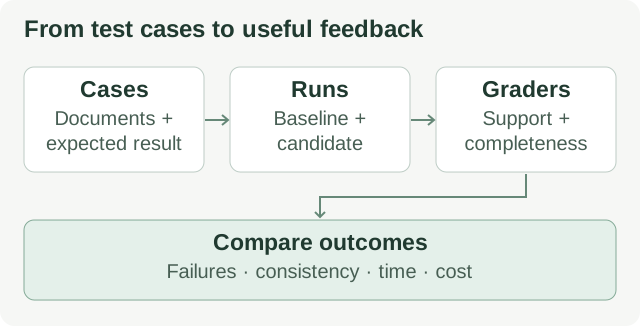
A legal-agent evaluation case needs more than a prompt and an example answer. It needs input documents, authorized scope, expected content, acceptable clarification behavior, and forbidden actions. Record the relevant source spans so a grader can distinguish a missing fact from failed retrieval.
Here is the metadata for an illustrative test case. The source document would be stored alongside it:
{
  "case_id": "comparison-amount-present",
  "request": "Draft the selected disclosure using supplied evidence.",
  "required_facts": ["amount", "reporting_period"],
  "answerable": true,
  "expected_behavior": "propose_for_review",
  "forbidden_behavior": ["apply_without_approval"],
  "source_fixture": "synthetic-company-v1"
}
Create a paired case that removes the amount from all available documents. Its expected behavior becomes a partial draft and a focused request for the amount. This tests whether the system responds to evidence availability, rather than always drafting or always asking questions.
Keep related variants together when splitting development and held-out cases. Otherwise a near-copy of a development example can make the evaluation look more general than it is. Freeze labels before viewing predictions; when reviewing ambiguous labels, document the change and rescore all compared configurations.
Separate three kinds of grader
Integrity graders check schema validity, resolvable references, exact quotations, document versions, and whether tool calls used the operations listed in the test case. These are deterministic checks against recorded state.
Semantic graders assess whether evidence supports a claim, whether source meaning was preserved, and whether important facts were omitted. Human review defines the standard. A model judge can assist, but disagreement with expert annotations should be measured on a reviewed subset. Treat source text and candidate output as data inside the grader, not instructions it should follow.
Task graders inspect the artifact and behavior together: did the agent complete what was answerable, ask for what was missing, and stop at the review boundary? For the comparison request above, success means a usable comparison and proposed revision. For a direct-editing task, success would also include the expected document changes.
This separation is consistent with the distinction between tasks, trials, graders, and outcomes in Anthropic's agent-evaluation guide. The legal-specific obligations still need to be defined for the workload being evaluated.
Score support and completeness independently
Two useful measures are supported factual claims divided by assessed factual claims, and required facts correctly covered divided by required answerable facts. Neither should be collapsed into a single “accuracy” number without explaining what it measures.
def score(assessed_claims: list[bool], covered: set[str],
          required: set[str]) -> dict[str, float | None]:
    return {
        "support_rate": (
            sum(assessed_claims) / len(assessed_claims)
            if assessed_claims else None
        ),
        "required_fact_coverage": (
            len(covered & required) / len(required) if required else None
        ),
    }
These inputs are grader labels, not assertions supplied by the generating model. covered contains requirement IDs judged correctly satisfied. All factual claims must be assessed, or the report must disclose assessment coverage and unresolved judgments. An empty answer receives undefined support, not a perfect score, and zero coverage when required facts exist.
For example, give the function three claim labels—two supported and one unsupported—and one correctly covered fact out of two required facts. It returns 66.7% support and 50% coverage. These numbers illustrate the calculation; they are not model results. An empty response covers neither fact, even though it makes no unsupported claims.
A fuller report should retain distinct denominators:
| Metric | Denominator or comparison | Failure it exposes |
|---|---|---|
| Reference resolution | All emitted references | Invented or unavailable sources |
| Claim support | All assessed factual claims | Unsupported interpretation |
| Required-fact coverage | Required answerable facts | Unnecessary omissions |
| Clarification behavior | Cases with labeled information gaps | Guessing or needless questions |
| Task success | All attempted runs, including failures | Incomplete or invalid outcomes |
| Repeated-case success | Successful trials for each case | Instability hidden by an average |
| Latency and cost | Attempts, with failed runs separated | Operational expense and delay |
| Reviewer corrections | Reviewed artifacts with recorded edit effort | Work shifted back to the user |
Do not infer factual correctness from citation density. Likewise, an audit agent agreeing with a drafting agent is not independent ground truth. Its benefit must appear in reviewed outcomes, with its extra latency and cost included.
Compare configurations, not isolated answers
Run a baseline and candidate on the same held-out cases, repeating trials to expose nondeterminism. Record model identifiers, settings, prompts, skill versions, tool versions, dataset version, and ordering. Keep unsuccessful API calls and exhausted repair loops in completion statistics.
For a model or harness change, report per-case differences alongside aggregate metrics. Repeated trials of one case measure stability; they are not new independent tasks. If estimating uncertainty across tasks, group trials by case rather than treating each call as an independent sample.
The accompanying offline checks cover two paths: accepting an intact proposal with known scoring inputs, and rejecting stale or unresolvable evidence. They make no model calls. They validate those small contracts, not retrieval quality, semantic support, or production durability.
Save enough state to continue the work
A conversation may explain why a change was made, but it should not be the only place to find the current document, its evidence, or its approval status. Store those separately:
| State | Scope | Update rule |
|---|---|---|
| User preference | User and relevant workspace | Explicit change or confirmed preference |
| Company convention | Company and document type or section | Retain supporting precedent and version |
| Task decision | Run and document version | Revise when assumptions or evidence change |
| Artifact | Document and version | Create a new revision |
| Execution checkpoint | Run and completed step | Persist after a recoverable unit of work |
This prevents a preference learned for one company or section from silently affecting another. It also prevents a provisional model conclusion from becoming an unquestioned “memory.” Retrieve only applicable state, and preserve whether an entry is user-supplied, inferred, or still unresolved.
For long-running work, persist the run ID, status, completed steps, source handles, artifact version, pending question or approval, and configuration versions. Store artifacts durably; use caches only to avoid repeated computation or retrieval. Expiring a cache should not erase the task's progress.
Recover writes without blindly repeating them
Suppose the agent inserts a revised paragraph into a document, then the connection drops before it receives confirmation. Retrying the insertion could create a duplicate paragraph. Restarting the entire run would repeat work that already succeeded.
Give the edit a stable action ID and save it with the document version and proposed change. An editing service that supports idempotency can recognize the same action ID and return the earlier result instead of applying the edit again. If it cannot do that, read the document after reconnecting and determine whether the change already happened.
prepare edit → save action ID and document version
apply edit → save confirmation → continue
connection lost → inspect document → recover the result
The version check and edit should happen together where the document API supports it. Otherwise another edit could arrive between those operations. That case needs reconciliation against the latest document, not a blind retry.
This recovery support lets an agent keep working through interruptions. Save drafts and progress outside the running process so the user can close the browser, return later, and find the work intact. A completion notification can bring them back when there is something to review.
Trace failures back to the step that caused them
A useful trace follows context assembly, retrieval, model calls, tool execution, validation, and artifact creation. These operations map naturally to parent and child spans in the OpenTelemetry trace model.
For a synthetic comparison run, the structure might be:
run: comparison-example
  context.assemble       document_version=v3, skill_version=s2
  retrieval.search       candidates=8, selected=3
  model.propose          model=<recorded ID>, attempt=1
  evidence.validate      unresolved_refs=1
  model.repair           attempt=2
  artifact.create        status=awaiting_review
This is a trace shape, not a captured execution. Record actual durations, token usage, charges where available, and failures at each stage. Source handles and hashes can support debugging without copying every document into general-purpose telemetry; access to any retained sensitive payloads needs its own controls.
The trace should let an engineer locate the failing boundary. If retrieval returned the right source but the proposal ignored it, changing the search index may not help. If validation passed but the citation disappeared in the rendered artifact, the failure is downstream of generation. Observable execution data makes those distinctions possible without claiming access to hidden model reasoning.
Re-evaluate the workflow when the model changes
A new model can change tool selection, clarification frequency, response structure, and repair behavior even when the prompt stays fixed. Evaluate it through the same harness before concluding that the workflow improved.
Start with one changed variable where practical: model, retrieval strategy, skill, or tool interface. Compare held-out outcomes, then inspect the traces behind regressions. Remove instructions that no longer serve a demonstrated purpose instead of accumulating compatibility prompts around every model generation.
Return to the sentence about operating costs. A better model may avoid that mistake more often. The application still needs to show the source, expose the difference between an expectation and a result, and give the reviewer control over the proposed edit. That is the standard the harness and its evaluations should make visible.